
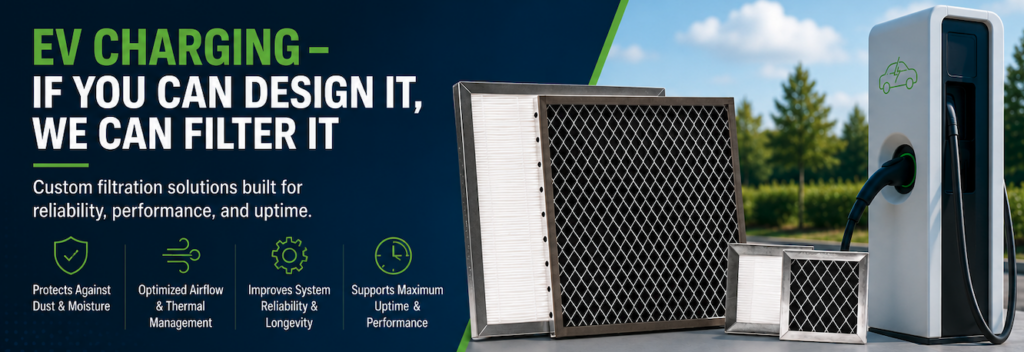
As electric vehicle infrastructure continues to expand across North America, EV charging stations are being deployed in increasingly demanding outdoor environments. From highway corridors and urban parking structures to fleet depots and remote charging installations, these systems face constant exposure to dust, moisture, airborne contaminants, and fluctuating temperatures.
For OEMs, system designers, and infrastructure providers, airflow management and environmental protection are no longer secondary considerations. They are critical to system reliability, thermal performance, and long-term operational uptime.
The Growing Challenge of Outdoor EV Charging Protection
Unlike traditional indoor electronics, EV charging systems operate in unpredictable environmental conditions. Exposure to contaminants such as road dust, pollen, dirt, moisture, and debris can significantly impact cooling efficiency and electronic stability over time.
Without proper filtration, airborne contaminants can infiltrate enclosures and create several operational risks, including:
- Restricted airflow
- Increased internal operating temperatures
- Accelerated component wear
- Reduced cooling efficiency
- Premature equipment failure
- Increased maintenance requirements
As charging systems become more powerful, thermal loads continue to rise. Higher power density generates additional heat, making airflow optimization increasingly important for protecting sensitive electronics and maintaining reliable performance.
Why Air Filtration Is Critical for EV Charging Infrastructure
Effective air filtration plays a direct role in protecting EV charging systems from environmental contamination while supporting proper airflow throughout the enclosure.
Poor airflow management can force cooling systems to work harder, increasing energy consumption and internal temperatures. Even minor airflow restrictions can negatively impact component lifespan and system stability.
Modern EV charging infrastructure requires filtration solutions that balance two critical objectives:
- Environmental protection against contaminants and moisture
- Low airflow restriction for optimized thermal management
Achieving both simultaneously often requires a custom-engineered approach.
Why Off-the-Shelf Filters Often Fall Short
Standard filtration products are rarely designed around the unique requirements of EV charging systems. Charging enclosure designs vary significantly based on:
- Power levels
- Cooling architecture
- Airflow pathways
- Mounting constraints
- Outdoor exposure conditions
- Maintenance accessibility
- Environmental protection requirements
Because of these variations, generic filtration solutions may create airflow inefficiencies, sealing issues, or inadequate environmental protection.
Custom air filtration solutions allow engineers to optimize filtration performance specifically for their application.
Benefits of Custom EV Charging Air Filters
Custom-fit air filtration solutions provide several advantages for EV charging equipment manufacturers and infrastructure providers.
Optimized Airflow Performance
Custom filters can be engineered around exact airflow targets and enclosure geometries to minimize pressure drop while maintaining filtration efficiency.
Enhanced Environmental Protection
Depending on the application, filtration systems may incorporate:
- Hydrophobic filter media
- Custom gaskets
- Ruggedized frame materials
- Water-resistant designs
- Dust-loading optimization
- Outdoor-rated configurations
Improved Thermal Management
Proper airflow is essential for maintaining stable operating temperatures in high-power charging systems. Engineered filtration solutions help support cooling efficiency without excessive airflow restriction.
Increased System Reliability
Reducing contaminant ingress helps protect sensitive electronics from premature degradation and performance instability.
Simplified Maintenance
Custom designs can also improve serviceability and long-term maintenance efficiency, helping reduce downtime and operational costs.
Uptime Is Becoming a Competitive Advantage
As EV charging networks scale, uptime expectations continue to increase. A charging station that is offline due to overheating, contamination, or cooling inefficiencies impacts more than operational performance—it directly affects customer experience and brand perception.
Infrastructure providers are increasingly prioritizing components and design strategies that support long-term reliability throughout the lifecycle of the system.
This includes evaluating:
- Airflow efficiency
- Environmental resistance
- Dust-loading characteristics
- Thermal management performance
- Long-term maintenance requirements
Filtration is becoming a core part of the overall reliability strategy.
The Future of EV Charging Depends on Reliability
The EV industry continues to evolve rapidly, but one challenge remains consistent: protecting sensitive electronics in harsh outdoor environments.
As charging systems become more advanced and more widely deployed, engineered airflow and filtration solutions will continue to play a critical role in maintaining:
- System performance
- Thermal stability
- Equipment longevity
- Operational uptime
- Customer satisfaction
At Universal Air Filter, custom filtration solutions are designed to help OEMs and engineers protect mission-critical electronics across demanding applications—including EV charging infrastructure. If you can design it, UAF can filter it.
Contact UAF for Custom EV Charging Filtration Solutions
Whether you are designing Level2 chargers, DC fast charging systems, fleet charging infrastructure, or outdoor power electronics, custom-engineered filtration can help improve reliability and long-term performance.
Learn more about custom filtration solutions by a UAF Engineer, TODAY!